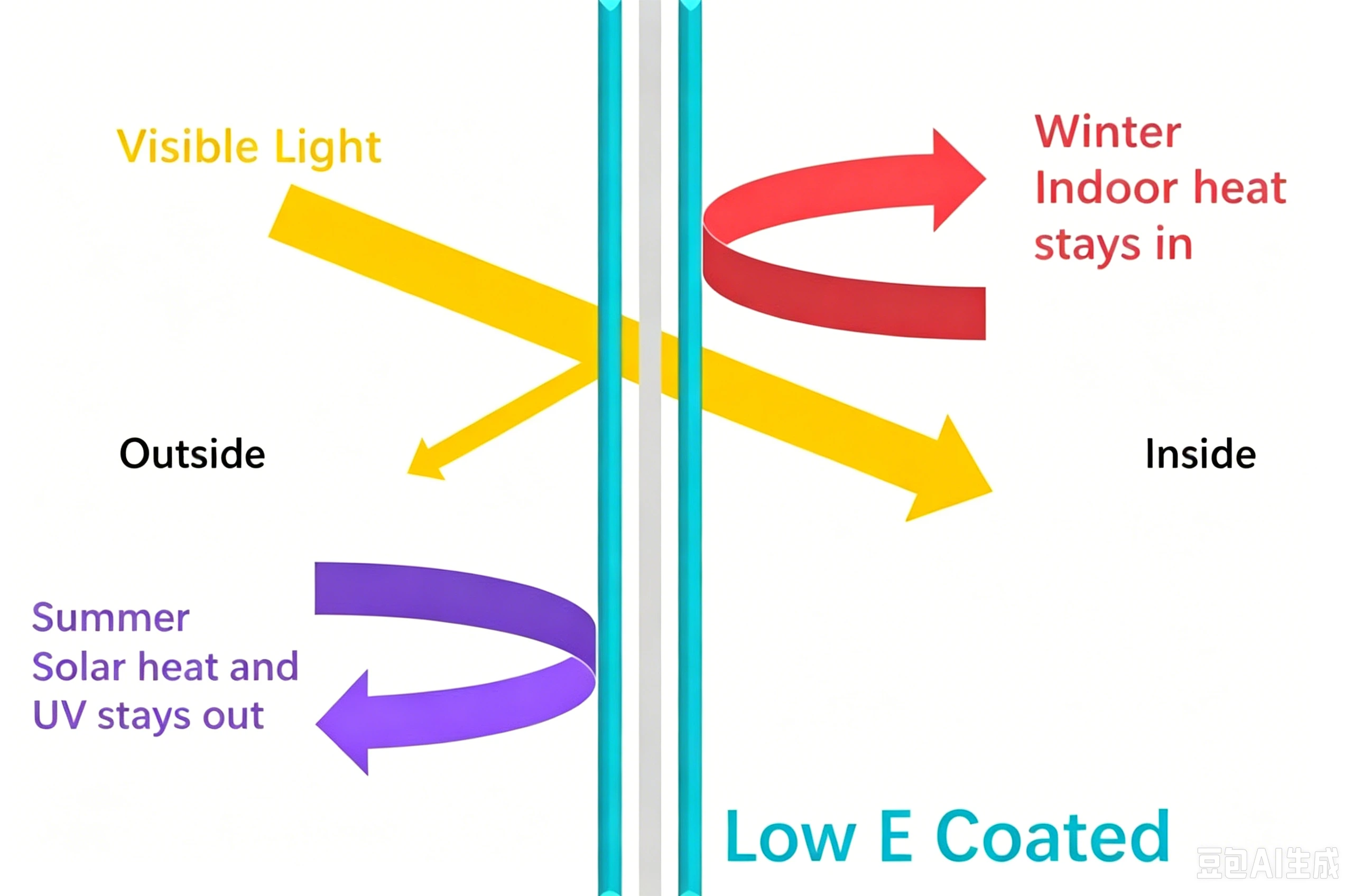
Low-E glass, short for low-emissivity glass, is glass with a microscopically thin coating designed to reduce radiant heat transfer. The coating reflects selected infrared energy while allowing useful visible light through, helping an appropriately designed window retain indoor heat in cold conditions and limit solar heat gain in warm conditions.
What is Low-E glass?
Low-E glass is energy-efficient glazing with a thin, visually subtle coating of metal, metal oxide, or a multilayer coating system on one glass surface. “E” stands for emissivity, a surface's ability to emit thermal radiation. A lower-emissivity surface emits and exchanges less long-wave infrared heat than ordinary uncoated glass.[1][2]
The coating is spectrally selective: it manages different wavelength bands differently. A well-designed product can preserve daylight while controlling thermal infrared and, for solar-control products, a larger share of solar near-infrared energy.
Low-E is not a complete window type by itself. It is a coating technology used within a glazing system. Final performance also depends on the number and thickness of panes, air or gas spaces, coating position, spacer, frame, edge construction, size, orientation, and installation.
| Characteristic | Float (Clear) Glass | Low-E Glass |
|---|---|---|
| Surface coating | No low-emissivity coating | Microscopically thin functional coating |
| Long-wave radiant heat transfer | Higher | Lower |
| Solar heat control | Mainly determined by clear-glass absorption and reflection | Can be tuned for higher or lower solar heat gain |
| Visible daylight | Generally high for clear glass | Selected VLT; may range from highly transparent to darker or more reflective |
| Appearance | Usually neutral | May have a subtle tint or reflectance depending on coating design |
How does Low-E glass work?
Heat crosses a window through conduction, convection, and radiation. Low-E coatings primarily address the radiative component. Their high infrared reflectance and low emissivity reduce long-wave thermal radiation exchanged between warm and cool surfaces.
In cold conditions: the coating reflects more room-temperature, long-wave infrared energy back toward the warmer side, reducing radiant heat loss.
In sunny or hot conditions: a solar-control Low-E coating rejects more incoming solar near-infrared energy, reducing unwanted heat gain and cooling demand.
For daylight: the coating is designed to transmit a selected amount of visible light, so thermal control does not require an opaque barrier.

Which performance metrics matter for Low-E glass?
A Low-E label alone does not show whether a product fits a project. Compare the following four ratings for the complete proposed glazing or window configuration.[3]
| Metric | What it measures | How to interpret it |
|---|---|---|
| U-value / U-factor | Rate of non-solar heat flow through the glazing or complete window, commonly expressed in W/(m²·K) in SI units | Lower means better insulation. Confirm whether the value is glass-only, center-of-glass, or whole-window. |
| VLT / VT | Visible light transmittance: the fraction of visible daylight passing through, stated from 0 to 1 or as a percentage | Higher means more daylight, but the best value depends on glare, privacy and design goals. |
| SHGC | Solar heat gain coefficient: the fraction of incident solar energy entering directly plus the inward-flowing part of absorbed energy | Lower means less solar heat gain. A higher value may be intentional in a passive-heating strategy. |
| LSG | Light-to-solar gain ratio: VLT divided by SHGC | Higher means more daylight relative to solar heat gain. It describes spectral selectivity, not insulation. |
LSG example: if VLT is 0.70 and SHGC is 0.35, then LSG = 0.70 ÷ 0.35 = 2.0. Use decimal values—not one percentage and one decimal—in the calculation.[2]
U-value and SHGC answer different questions. U-value describes heat transfer driven by an indoor–outdoor temperature difference; SHGC describes heat added by the sun. A glazing product needs both ratings to characterize thermal performance.
What are the core benefits of Low-E glass?
Lower heating and cooling demand: reducing radiant heat transfer can decrease the load placed on HVAC systems. Actual savings depend on climate, building design, glazing area, orientation, controls and the complete window assembly.
Warmer winters and cooler summers: low emissivity helps retain indoor warmth, while an appropriate solar-control coating can reduce overheating from direct sun.
Improved thermal comfort: better control of interior glass-surface temperature can reduce the hot-window or cold-window radiant discomfort felt near glazing.
Useful daylight with controlled heat: spectrally selective coatings can admit substantial visible light while rejecting a larger share of unwanted solar heat.
Reduced UV transmission: many Low-E constructions reduce ultraviolet transmission and can help slow fading of furnishings and finishes.
UV protection needs a qualification: Low-E glass does not universally block all UV, and no glazing prevents all fading because visible light, heat, humidity and material sensitivity also contribute. For museums, displays or other sensitive interiors, specify tested UV or damage-weighted transmittance and consider laminated glass with a UV-absorbing interlayer.[6] Aoptek's related test article shows why UV performance must be checked for the exact Low-E IGU construction.
Where is Low-E glass commonly used?
| Application | Typical performance priority | Design note |
|---|---|---|
| Building curtain walls | Solar control, daylight, facade color, low U-value and high LSG | Evaluate each orientation; large glazing areas make SHGC and visual consistency especially important. |
| Residential windows and doors | Low U-factor, climate-appropriate SHGC, daylight and comfort | Select passive or solar-control performance according to heating and cooling needs rather than using one coating everywhere. |
| Energy-efficient insulating glass | Protected coating, low U-value and controlled solar gain | Combine the Low-E pane with the specified cavity, gas fill, spacer and coating position; verify the finished IGU rather than only the coated lite. |
| Cold‑chain industry | Low U-value | Reduce the U-value, prevent heat transfer caused by temperature difference between the inside and outside of the freezer, and save power consumption. |
The correct product is project-specific. Climate zone, facade direction, window-to-wall ratio, external shading, glare limits, energy code and desired appearance should be evaluated together.
How is Low-E glass performance measured?
Low-E performance cannot be confirmed reliably from appearance alone. Spectral transmittance and reflectance, coating emissivity and position, glass/air-space structure, and the relevant standard calculations are used to verify the specified values.
GlasSpec2500 — laboratory and factory measurement of 300–2500 nm spectrum, VLT, solar parameters, g value, LSG, Ug and related values for single glass or a complete IGU.[7]
GlasSmart1000 — on-site, non-destructive measurement of installed insulating glass structure, Low-E position, emissivity, U-value, SHGC and optical parameters.[8]
GlassMeter800K — portable inspection of DGU/TGU thickness and air spaces, Low-E position, E-value and calculated U-value.[9]
Filmonitor6110 and Filmonitor6300 — online spectral and color monitoring options for Low-E coating production.[10]

Instrument note: select equipment according to whether the sample is a coated lite, finished IGU, installed window or moving production ribbon. Confirm the current datasheet, applicable standard and representative sample range before testing.
Frequently asked questions
What is Low-E glass?
Low-E glass, short for low-emissivity glass, has a microscopically thin metal or metal-oxide coating that reduces radiant heat transfer while allowing useful visible light to pass.
How does Low-E glass work?
Its low-emissivity coating reflects long-wave infrared energy, reducing radiant heat exchange across the glazing. Solar-control Low-E coatings also reject more incoming solar infrared energy while retaining useful daylight.
Does Low-E glass keep heat in or out?
It can do both. Low-E glass reduces long-wave radiant heat loss from a warm interior, while solar-control Low-E glass also limits incoming solar heat; the balance depends on the coating design and glazing configuration.
What is the difference between passive and solar-control Low-E glass?
Passive Low-E glass is designed to admit more solar heat and is often suited to heating-dominated climates. Solar-control Low-E glass has a lower solar heat gain coefficient and is commonly selected where reducing cooling loads and excessive solar gain are priorities.
What is the difference between Low-E glass and float (clear) glass?
Float (clear) glass has no low-emissivity coating and therefore permits more radiant heat exchange. Low-E glass adds a spectrally engineered coating that improves thermal control while preserving a selected level of visible light.
Is Low-E glass the same as tempered glass?
No. Low-E describes an energy-control coating, while tempered describes a heat treatment that changes glass strength and breakage behavior. A compatible glass product can be both Low-E coated and tempered.
Does Low-E glass block UV radiation?
Low-E glass can reduce UV transmission, but the amount varies by coating and glazing construction, and it does not guarantee complete UV protection. For highly sensitive interiors, specify tested UV performance and consider laminated glass with a UV-absorbing interlayer.
Which ratings should be checked when selecting Low-E glass?
Check U-value or U-factor for insulation, SHGC for solar heat gain, VLT or VT for daylight, and LSG for daylight relative to solar heat gain. Compare ratings for the same scope, such as glass-only, center-of-glass, or whole-window performance.
Need to verify Low-E glass performance?
For an instrument recommendation, provide the glass or IGU construction, sample size, expected coating type, required parameters and standards, and whether testing will be performed in a laboratory, on installed glazing or online.
Related reading
References and technical sources
Efficient Windows Collaborative / NFRC Consumer Guide to Windows, “Low-E Coating.”
Efficient Windows Collaborative / NFRC Consumer Guide to Windows, “Introduction to Window Ratings.”
ISO 9050,Glass in building—Determination of luminous and solar characteristics of glazing.
EN 673,Glass in building—Determination of thermal transmittance (U value)—Calculation method.
National Glass Association,Screening Out Ultraviolet Radiation with Laminated Glass.
Aoptek, GlasSpec2500 product information and specifications.
Aoptek, GlasSmart1000 product information and specifications.
Aoptek, GlassMeter800K product information and specifications.
Aoptek, Filmonitor6110 and Filmonitor6300 product information and specifications.
Performance descriptions are general guidance, not values for a specific product. Verify the exact glass or whole-window ratings, applicable code, coating position and installation for each project. Instrument specifications are subject to change.